
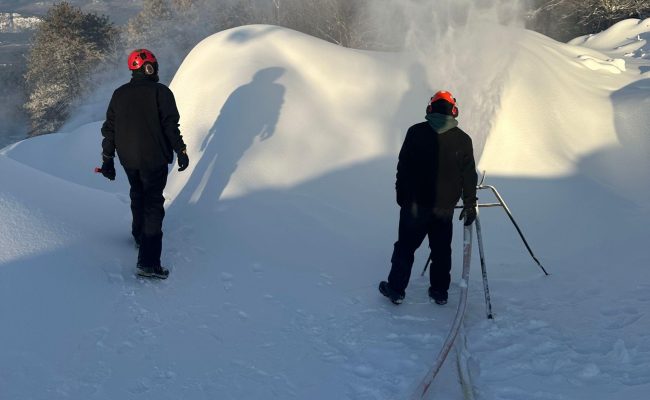
“My favorite part about the job is watching hundreds of people ski down a trail that had nothing on it a few days ago.”
For most skiers, that transformation feels almost magical. One weekend a trail is littered with grass and rocks piercing through a thin layer of snow. The next, a freshly groomed trail and new terrain to explore.
Behind that quiet transformation is Cranmore’s snowmaking team.
At 7am, before heading out to the mountain, their conversations sound much like any group of coworkers—talks about the regret of forgetting to pick up Big Dave’s for lunch, discussions of how to get a 6-foot pet iguana to the vet in the middle of winter, etc.
But it doesn’t take long to see beneath the easy banter and recognize a deep pride in what they do.
That morning, the crew rode up the Skimobile Express where they split up to attend to various trails. Riley and Jake were sent to Koessler, a trail the team had started making snow on just days earlier. To many, the trail would have looked like a wintery wasteland in its current state. To Riley and Jake, it was a result of meticulous planning to form even mounds of snow for the groomers to turn into corduroy overnight.
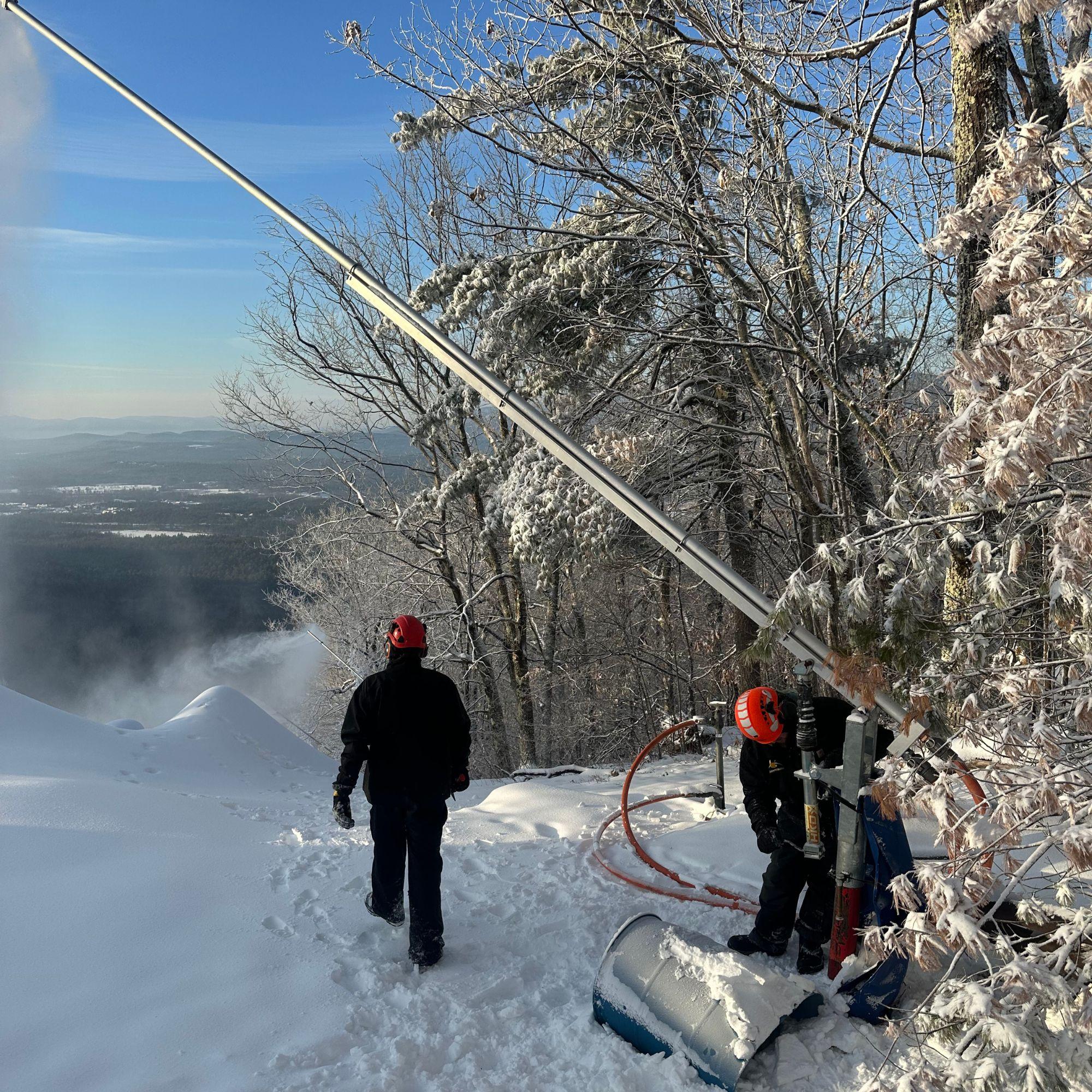
Riley and Jake assessing the snow piles and adjusting snowguns on Koessler. Last year, Cranmore added eight new HKD snow guns.
But the work on Koessler did not begin that morning, or even that week.
Planning the season
Long before the first snowgun is fired, the team measures every trail in the fall. Once they have the length and width, they are able to calculate how much snow is needed to open the trail. That information is then entered into a formula to determine the amount of water that will be required.
From there, the team builds a season-long plan that consists of 10 phases. The plan is adjusted from year to year as they push to improve the efficiency and speed of the process.
When temperatures drop into the low 20s, Cranmore’s 100% snowmaking coverage comes to life. In most cases, it takes no more than a few days to bring a trail from grass to ski-ready.
As with everything, technology in the snowmaking world changes fast, almost always with the same goal: to speed up the process while reducing energy usage.
Mountain Operations Manager John Mersereau, who has worked at Cranmore for more than 40 years, remembers when the job was far less efficient.
“It used to be a very labor-intensive process,” he explained, “Equipment was hauled all over the mountain by hand, often by large crews working long shifts through the night trying to move a limited number of guns fast enough to make the most of the available electricity and horsepower.”
Over time, Cranmore has made countless improvements to improve this process. Pipes, snowguns, hoses and hydrants were added across the mountain. Energy-efficient tower guns and fan guns replaced older equipment, allowing the crew to cover more terrain faster while using the same amount of energy.
Last year, the mountain also improved their underground infrastructure as the snowmaking pipe underwent a 500-foot expansion which created two separate systems in the snowmaking line. This helped the team boost and maximize pressure which resulted in higher quality snow and increased production rates.
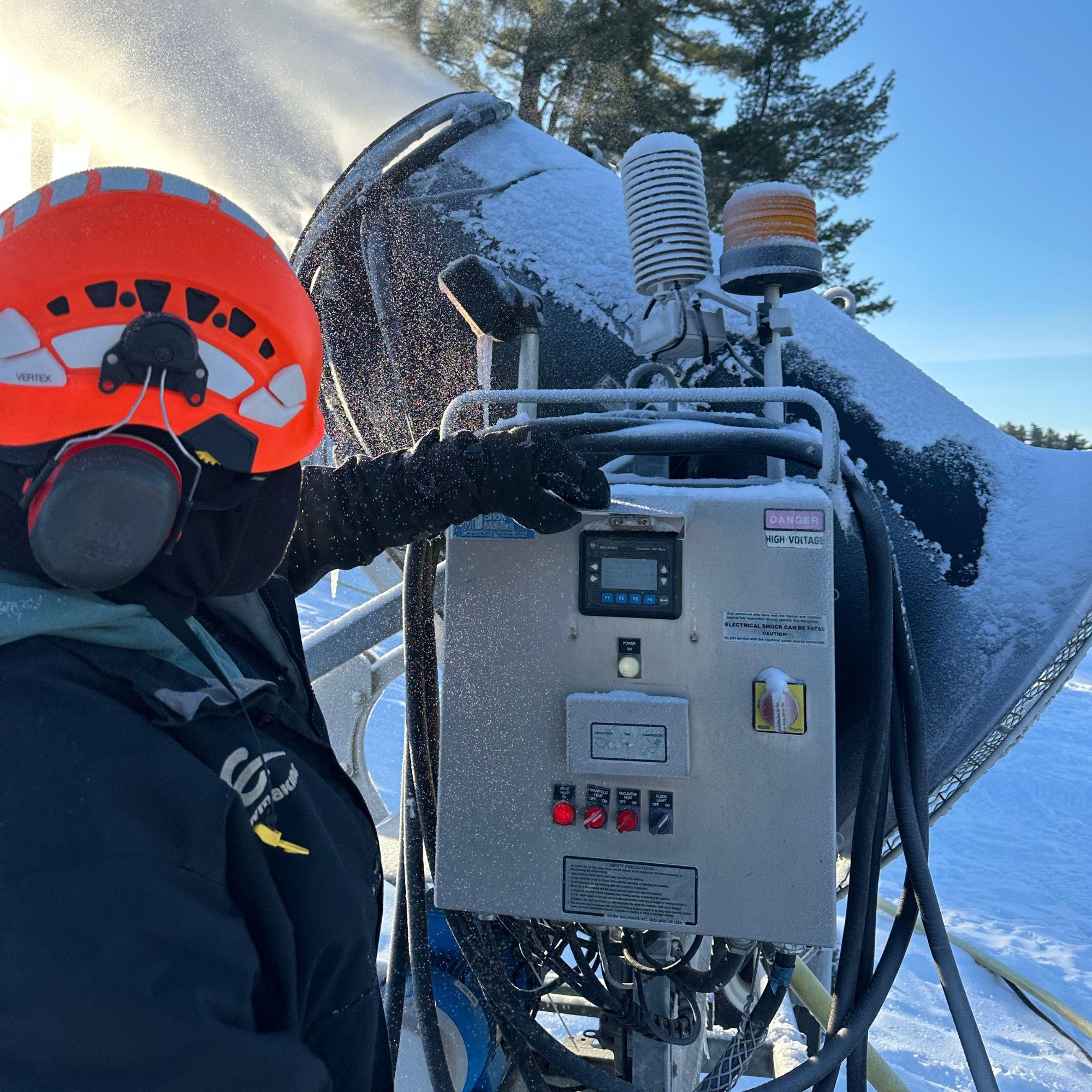
Riley operating the fan gun located on North Slope. Modern fan guns use precision nozzles and automated controls to make more snow using the same amount of energy.
Generations of Experience
New technology can only be as effective as the people running it. Fortunately for Cranmore, John has been around the resort his entire life, and holds the same position his father once did.
“My dad would have paid them to let him work here,” John said jokingly of his father’s commitment to the mountain.
Growing up, the mountain always came first. He described Cranmore as a place that felt like home to his family.
“We spent countless birthdays, Christmases, Thanksgivings, weekends and school vacations here with my dad—trying to help but mostly being kids and finding fun things to do while he worked,” John said. “As soon as I could walk, I was put on a pair of skis and let loose on the mountain. This place has always felt like home.”
Before long, John was old enough to work and got a job at Cranmore, following in his father's footsteps. John explained the value of learning from his father—the work ethic, the technical skills and the dedication required to excel in the industry.
“I could see through his eyes the passion he had for snowmaking and grooming and making Cranmore a success,” John said. “That made me a lot more vested in the art of snow farming and turning a hand to whatever needed doing for the success of the resort.”
Now in the same position his father once was, John sees his role less as inheriting a job and more as carrying forward a responsibility.
“I consider myself lucky to hold this position, and I look forward to getting up and going to work every day,” John said.
For John and his team, success is easy to measure.
A few days after Riley and Jake first started on Koessler, hundreds of skiers carved their first turns of the season down the trail.
Most never think about how it came to be.
But as the snowmaking team passes by the trail on their way to start another, they see what their work has become—a playground for families enjoying another beautiful winter day, a hub for longtime locals tallying another lap on one of their favorites and the start of countless memories to be made on the slopes.
“I’ve watched kids learn to ski here, then come back years later with kids of their own,” John said. “Being part of that community, knowing that what we do makes it all possible, that’s what makes this job so special.”